Welcome behind the hidden door of great stories.

Character gallery

Characters

Historical figures drawn from their real biographies and a wholly imagined world of guardian fairies — the characters who run through all of Maja’s books.

Click a character to read their story.
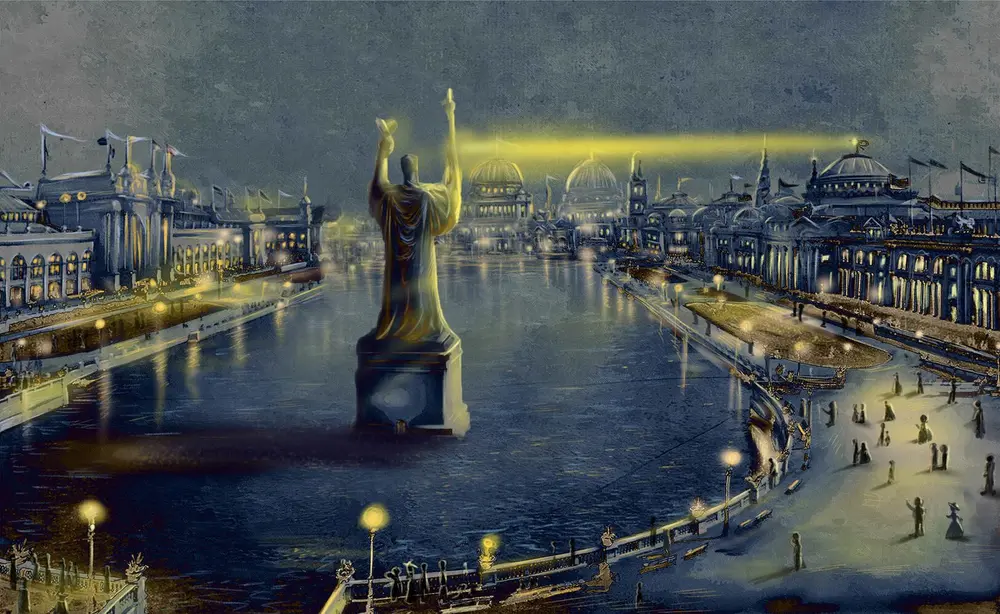
A night view of the Chicago World’s Fair — an illustration from the Maya Story world
The World’s Fair in Chicago — one of the places the characters travel through

Characters in the books of Maja C. S.

The writer Maja Cvetković Sotirov often points out that she builds her gallery of characters after the real world. Their traits, wishes and aspirations belong to people she has met over the course of her life. She paints the historical characters realistically, according to their biographical record (which is why her research goes on without pause in libraries, in the field and online), while the world of the guardian fairies is entirely imagined (though the characters, naturally, have the traits of people).

The interactions between the characters are highly instructive, and Maja’s books teach science, history, culture and art in an engaging way.

In Maja’s books we travel through the history of Paris, Chicago and New York by means of the scientific inventions that shaped the world as we know it today. So we travel through world history, and through national history as well.

Alongside national and world history, a great influence on the work of Maja C. S. comes from the celebrated writers of Serbian literature, while among the writers of world literature Dickens (“A Christmas Carol”, “The Little Match Girl”) and Balzac, with his whole “Human Comedy” gallery of characters, stand out.

  • Luka and Lana

    The heroes of Magical Sails

    Luka holding little Lana in his arms, surrounded by lightning

    Luka and Lana are the heroes of the book “Magical Sails — A Nikola Tesla Story”. They try to stop an evil force that wants to seize Tesla’s inventions and move into Tesla’s childhood in order to rule the world. Of course, they cannot do it alone: with them are the guardian fairy Anđelina and the peculiar Viloid — the fairy-robot.

    In the book Lana is three years old. She is in the stage of picking up speech, is very curious and mischievous, and dreams of becoming a fairy. Her pranks often solve a great many problems in the fast-moving plot — though just as often they cause them.

    Luka is seven and usually sounds like the voice of reason. Like Lana, he is very curious, but with a dose of caution.

    In real life Luka and Lana genuinely exist; they inspired the author with the bond between brother and sister. As they are growing up together (their fathers are brothers), they are often near the writer Maja, who is then Auntie Maja and Mummy Maja. With their questions, their thoughts, their behaviour and their pranks, both of them constantly prompt the author to reflect and to create.

  • Anđelina, the guardian fairy

    Guardian fairy of science

    The guardian fairy Anđelina above the Pascaline, among the blue blueprints of the machine

    Anđelina is the guardian fairy of science; she protects scientific inventions, works of art, scientists and artists. She is a friend to children and to people with a pure heart; she is clumsy with magic, and so often relies on science instead. Although she is “a bit of a muddle”, as the author describes her, luck is always on her side.

    She is one of the main characters and appears in the books: “Magical Sails — A Nikola Tesla Story”, “The French Adventure (A Story about Blaise Pascal)” and “The Boy and the Fairy”.

  • Gromlina

    The wicked fairy

    Anđelina and Gromlina face to face

    Gromlina is the wicked fairy — she grew up together with Anđelina. The two of them are the granddaughters of the famous Professor Nana. They grew up showered with love and were the best of sisters and friends, until one day Professor Nana unwittingly drew a distinction between her granddaughters and gave Anđelina the two most powerful things in the fairy world: the Diary of Magic and the flying machine Šklopocija — the fairy time machine. The other granddaughter she left with nothing. Why Nana did this only she knows, but with that act she caused a great deal of pain and created a new being of the fairy world: the wicked fairy Gromlina.

    She is one of the main characters (sometimes a hero, sometimes an anti-hero) and appears in the books: “Magical Sails — A Nikola Tesla Story”, “The French Adventure (A Story about Blaise Pascal)” and “The Boy and the Fairy”.

  • Nikola Tesla

    The inventor — and the boy who saw the world differently

    The boy Nikola Tesla stroking a cat, sparks flying from its fur
    The boy Nikola Tesla and his pet friend the Cat discover electricity. Illustrator: V. Mančić (2020/2021).
    Nikola Tesla and the boy Luka in a beam of light
    The inventor Nikola Tesla and the boy Luka — worlds meeting in a collision of light. Illustrator: V. Mančić (2020/2021), with the book’s author Maja Cvetković Sotirov as creative adviser.

    In the book “Magical Sails — A Nikola Tesla Story” the inventor Tesla appears as a historical figure in adulthood, but also as a boy. Almost a hundred facts are woven into the plot, so that the reader learns about Tesla without being lectured.

    About his birthplace, his dreams, his family, his studies, his career, Paris, Chicago, New York, alternating current, the transformer, the notion of the “Columbus egg”, the 1889 EXPO (Paris) and the 1893 EXPO (Chicago) — the reader learns all of it unobtrusively, through the adventure of the boy Luka and the girl Lana, whose task is to defend Tesla’s childhood from a great evil.

    At the end of the book there are biographical details about the life and work of Nikola Tesla — they are there to round out the story and make it easier for readers to explore further.

  • Blaise Pascal and the Pascaline

    French mathematician, physicist and philosopher

    A night square in Clermont-Ferrand, Blaise Pascal in front of the cathedral

    Blaise Pascal — French mathematician, physicist and philosopher. He was born in the 17th century in Clermont-Ferrand. He built the first mechanical calculator (an adding machine, a mechanical abacus) to help his father with his work. The machine was named the Pascaline, and a model of it can be seen today in Clermont-Ferrand, in a section of the Lecoq museum whose first floor is devoted to the work of Blaise Pascal. In recognition of his enormous contribution to engineering and to science in general, many scientific terms bear his name, among them the unit of pressure (Pa).

    In the book “The French Adventure” (A story about the scientist Blaise Pascal and the first calculating machine) Blaise Pascal appears as a historical figure in his boyhood, but also in the period when he had become a recognised and respected scientist.

  • Viloid

    A robot fairy, a robo-fay

    Viloid, the fairy-robot with a top hat over his head
    Viloid in full figure
    Illustrator V. Mančić: Viloid — the fairy-robot, friend and adversary.

    Viloid is a new character in children’s literature; he “came to life” in the book “Magical Sails — A Nikola Tesla Story”. Viloid is a blend of science and fairy magic: a fairy-robot. His hardware (his appearance, his outfit) is a product of technology and science, while what drives him is fairy software. Viloid is brilliant with both science and magic; the only thing he lacks is acceptable behaviour among people — his emotional intelligence is “robotic”.

    Through the way Viloid is “shaped” over the course of the plot, the writer Maja Cvetković Sotirov raises questions about the development of artificial intelligence and its influence in the modern world: can a fairy-robot be a friend, and what is friendship anyway? How does Viloid understand the progress of science, and who is the inventor Nikola Tesla in his eyes (that is, in his programming)? Will Luka and Lana come to love him, and why does the guardian fairy Anđelina sometimes keep him at a distance?

  • Šklopocija

    The fairy time machine

    Šklopocija — a flying machine with a propeller, lanterns and a life ring

    Šklopocija was built as a flying machine by the fairy-scientist Beskrila, who made it out of an old fairy submarine. The machine has a propeller, a life ring and a lantern (because long ago Anđelina did not know how to “switch the electricity on”), and also a winding key. That key is no ordinary one — it is special in every sense: borrowed from an ancient tin of fish.

    Šklopocija is used for travelling through space and time. It starts up by itself when a great danger threatens the survival of the world.

    Šklopocija has belonged to the family of the guardian fairy Anđelina for several generations now.

  • The evil scientist

    The librarian who could not bear another’s success

    The evil scientist in a long coat, in a library corridor

    Long ago an old, wealthy family hired a quiet, withdrawn gentleman to look after their household library. That young librarian was no ordinary man: he had suppressed his ambition to become a scientist and settled for his new post, spending hours arranging books of every kind.

    The job proved to be a splendid opportunity to meet a real scientist, who happened to be the son of the library’s owner. They soon became friends; the young scientist was delighted with his new employee and invited him into his laboratory. It never crossed his mind that he had beside him a man full of envy, a false friend who could hardly bear another’s success.

    The librarian’s dark side came to light when the young scientist built a calculating machine. The old ambition awoke. He planned how to steal the real scientist’s success and become the most powerful of all — he would seize the calculating machine and turn it into a time machine, and then shape the world as he pleased. He intended one day to seize every invention of every scientist, and above all the genius of Nikola Tesla.